 Fächer



Friday, July 3, from around 9:15 pm
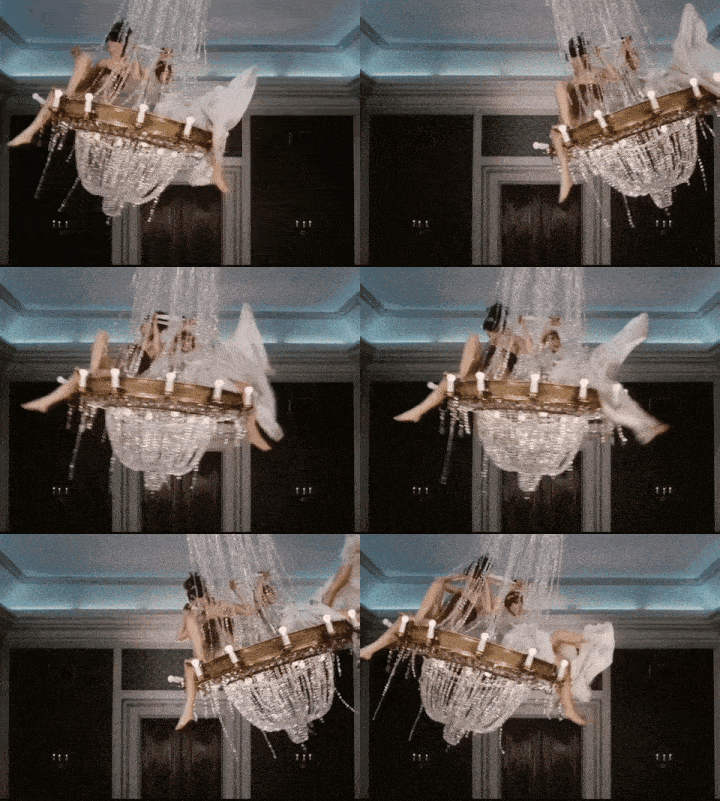
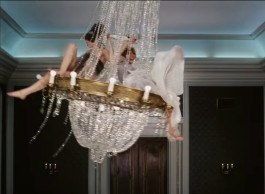
Daisies (1966, 73 min) by Věra Chytilová will be projected onto the FÄCHER window.
Daisies (Sedmikrásky) is Věra Chytilová’s best-known film and one of the key works of the Czechoslovak New Wave. At its centre are Marie I and Marie II, two young women who reject social and patriarchal norms, challenging established conventions through their behaviour.
Using fragmented storytelling, unconventional editing, and shifts between colour and black-and-white, the film combines formal experimentation with a critical reflection on Czechoslovak society in the 1960s. Following its release, Daisies was banned by the authorities and is now regarded as one of the most significant works of European auteur cinema.
Daisies (1966, 73 mins) by Věra Chytilová
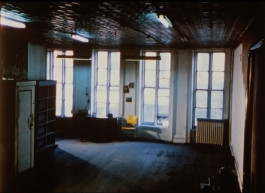
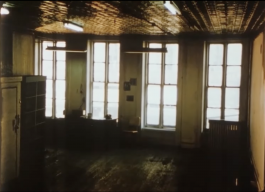
On Thursday, 11 June, from around 9.15 pm, we will be projecting Michael Snow’s film Wavelength (1967, 45 mins) and the trailer for Skinamarink (2022, 1 min 42 sec) by Kyle Edward Ball onto the Fächer window.
Michael Snow’s Wavelength is considered one of the key works of experimental cinema. The film combines image, time and sound into a concentrated exploration of cinematic form and duration.
At its centre is a New York loft space in which various events—some casual, some enigmatic—unfold over the course of the film. A continuous camera movement constantly alters the perception of this space and determines the film’s structure. The soundtrack combines ambient sounds, voices and an electronic composition whose gradual development is closely interwoven with the film’s visual structure.
Following this, we will screen the trailer for Skinamarink (2022) by Kyle Edward Ball. Here, too, the perception of space is central: rather than a continuously unfolding environment as in Wavelength, we encounter a fragmented, unstable house in which orientation gradually dissolves. The film reinforces the perception of space as something uncertain and atmospheric.

Music: Darius Milhaud
Narrator: Ben Danou
Camera: André Raymond
The sound version of The Seahorse was released 1934 in a boom period for diving, with vast improvements being made to equipment, enabling divers to move freely and breathe underwater. It was one of the first films ever to use underwater footage and Painlevé – who shot first at the Bay of Arcachon, then in the gigantic seawater aquariums of Parisian basement flat – used a special camera device placed in a waterproof box with a glass plate for the camera’s lens. The diving equipment he used was quite rudimentary and the camera could only shoot a few seconds at a time.
There is something magical and ethereal about the seahorse’s movements in the sea. Gently defying gravity, drifting its way through the waves and hanging upside down, its movement seems almost human (it is the only vertebrate sea creature that swims standing up) and the round shape of the eye seems to express permanent sadness. The male, accomplishing a kind of placentation, will fertilise the hundred eggs passed to him by the female seahorse. The cinematic effect is mesmerising, and the inversion of sex roles gave Painlevé a way to address the balance between the genders. His exploration of the birthing of seahorses concludes with a graceful ballet. At the end of the film, with a last touch of fantasy seahorse tails link up to create the word fin (the end).
Jean Painlevé (1902–1989) was a French filmmaker, known for his experimental nature films. In the 1920s and 30s, he moved in Surrealist circles, influencing them with his poetic visual language.